
test
By the Vomela Team
In 1930s Hollywood, studio executives settled on a number that has outlived nearly every marketing theory built on top of it: A prospect needs to encounter a message at least seven times before acting on it. Nearly a century later, the Marketing Rule of 7 is having a moment again—not because marketers have run out of ideas, but because the math has quietly turned against them. Reach has never been cheaper to get, but attention has never been harder to hold. The seven impressions that once came from a radio spot, a billboard, and a newspaper ad now must be assembled from a far more fragmented toolkit.
Direct mail is one channel where that shift is especially visible, as PFL recently outlined. But the broader 2026 story is about how physical and digital touchpoints work together—on the road, in stores, at events, and on the kitchen table—to rebuild the kind of familiarity the Rule of 7 was always really about. Industry projections put U.S. retail revenue up 0.9 percent this year, reaching an estimated $7.6 trillion, driven largely by omnichannel strategies that treat physical presence as core infrastructure rather than a nice-to-have.
Evolution of the Rule of 7
The Rule of 7 is rooted in the mere-exposure effect, the well-documented psychological tendency to prefer things simply because we've seen them before. Familiarity, repeated enough across enough contexts, becomes preference. Preference then begets action.
What's changed is where those seven impressions originate. Today's equivalent is omnichannel consistency: the fleet graphic on the highway, the personalized mailer on the kitchen table, the window display downtown, and the targeted ad in a retail media feed all carrying the same brand and the same story. Seven touches only work if they feel like they are coming from the same hand.
Direct Mail: The Most Tangible Touchpoint
As third-party cookies continue to fade, direct mail has re-emerged as one of the most powerful physical touchpoints in the omnichannel journey. An email is deleted in seconds. A piece of mail gets handled, read, set aside, and often revisited.
The numbers back it up: In 2025, highly targeted direct mail campaigns averaged an ROI of $42 for every $1 spent, with retention up 25 percent and CPM roughly $700 lower than digital. With Vomela's acquisition of PFL, what was once a one-size-fits-all tactic is now a data-driven engine—integrated with platforms such as Salesforce, Adobe Marketo, and Iterable—so that physical sends can be triggered by digital behavior in near real time.
That shows up differently across industries:
- Healthcare: AI-driven segmentation lets providers send personalized wellness newsletters that drive measurably higher event participation and screening follow-through.
- Financial Services: Secure, compliant automation delivers high-value offers at the moment a customer is most likely to act, producing returns that can reach 10x or more.
- Nonprofits: Mission-driven storytelling through mail reaches donors who have long since stopped opening fundraising emails, lifting stewardship and giving in the process.
Small Screen to Big Picture: OOH and Retail Media
An effective omnichannel strategy in 2026 must physically inhabit the public and private spaces where people live, work, commute, and shop. That's where the seven touches happen.
- Fleet Branding: The fleet graphics services market is projected to surpass $4 billion by 2033, and it's easy to see why. A branded vehicle lives inside the exact conditions the Rule of 7 depends on: repetition, proximity, and routine. A commuter who passes the same branded truck three times a week is accumulating impressions a digital ad must pay for over and over. Modern digital printing has made fleet graphics faster to produce, easier to customize by route or region, and more sustainable in materials and application—a brand asset that keeps working long after a campaign cycle ends.
- Contextual Retail Environments: Retail media and window graphics deliver contextual advertising at the exact moment of a purchase decision. Cross-platform measurement tools now let brands map how a window graphic works in tandem with a mobile notification or a search ad to move a customer toward conversion. The physical store becomes as measurable as a digital dashboard, and the media plan starts to reflect how people really shop.
- High-Impact Graphics, Events, and Installations: Dimensional graphics, experiential installations, and branded environments ensure that when a brand shows up physically, it stays with the customer as a real experience. The same logic applies to campus and institutional environments, where consistent wayfinding, signage, and branded spaces shape how students, patients, employees, and visitors understand an organization long before they read a word of its marketing. Occupying space—on a retail floor, at an event, in a professional setting, during a commute—is what turns a message into something remembered.
What This Looks Like in Practice
For marketing and operational leaders weighing where to invest in 2026, a few priorities stand out:
- Make physical touchpoints as personalized as digital ones. Zero- and first-party data should drive what lands in a mailbox or shows up in a store, not just what appears in an ad unit.
- Trigger physical from digital. Connect the CRM and marketing platforms to print and production so that a mailer, a sample, or a kit goes out at the right moment in the customer journey—not merely as part of a monthly calendar.
- Measure physical the same way you measure digital. Unified dashboards that track attribution across mail, out of home (OOH), fleet, and retail alongside digital channels are no longer optional; they're what separate integrated programs from parallel ones.
- Treat tangibility as a trust asset. A well-made physical piece signals a level of care and permanence that a display ad simply can't match, and, in a low-trust media environment, that matters.
- Build sustainability in from the start. Eco-friendly materials and responsible production standards aren't a separate initiative—they're a baseline expectation for customers, employees, and regulators alike.
The First of Seven
The point of the Rule of 7 was never the number. It was the insight that trust and preference are built through repeated, consistent exposure across a person's real life—not in a single channel, and rarely in a single moment. In 2026, that life is lived across screens, streets, stores, and mailboxes every day, all day.
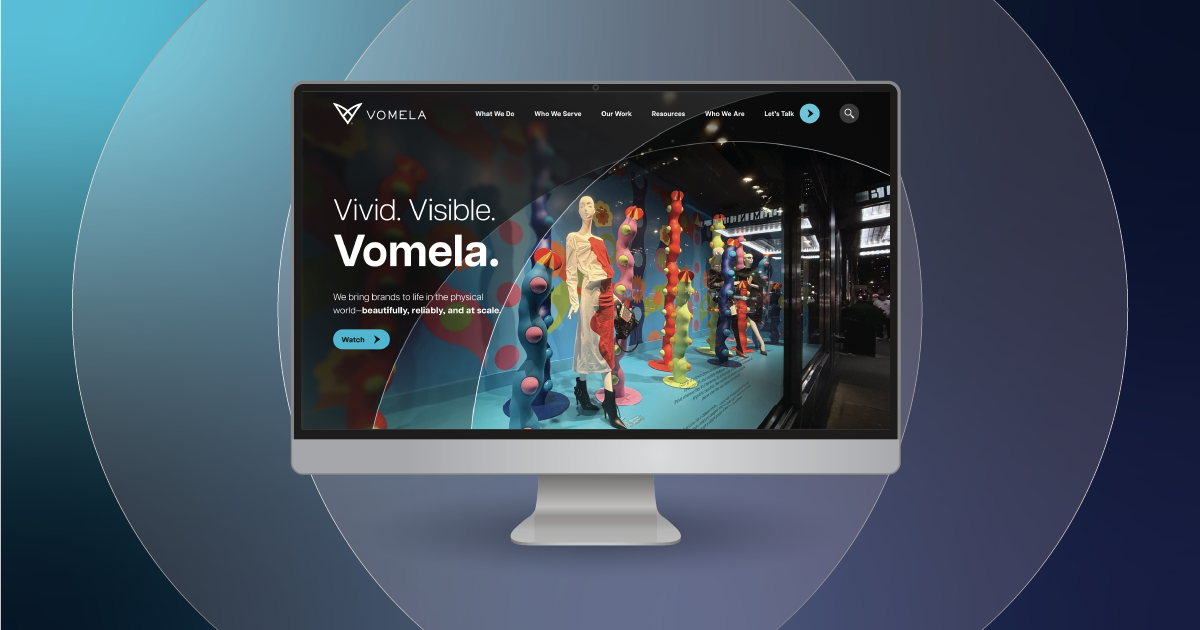
Whether the opportunity is direct mail, fleet branding, retail and window graphics, events and experiential installations, or institutional and campus environments, Vomela helps brands show up in the physical world in ways that are remembered. The technology, the craft, and the scale are in one place—working together to earn those seven impressions. No CGI required.