The Challenge
The main pain point for PODS was a disconnect between information and impact. The company already had a comprehensive long-distance moving guide—14 pages of practical advice designed to help customers prepare for container delivery, placement, packing, and logistics. But it was being delivered digitally, buried inside a busy post-purchase email. What’s more, it was competing with various real estate emails, mover coordination, and countless other urgent messages tied to a major life transition.
The guide had been sent digitally for some time and it wasn’t getting much engagement. The team believed that there was so much information being thrown at customers during a long-distance move that even if the email was opened, the PDF link was rarely clicked. At the same time, leadership had made reducing cancellations a priority. The CRM team needed a solution that did more than merely remind customers of their order—it had to reinforce PODS’ role as a trusted moving partner by providing clarity, confidence, and value at exactly the
right moment.
The Solution
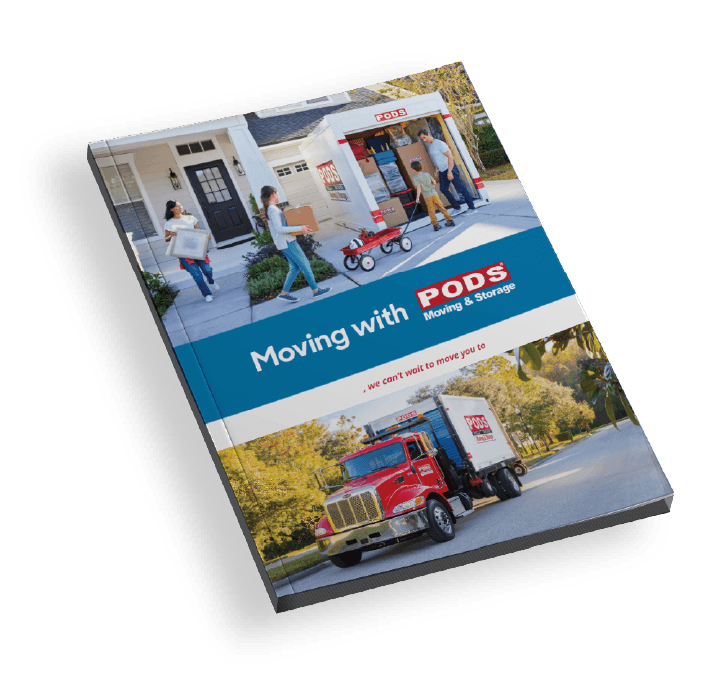
The idea was simple but deliberate: Take the moving guide out of the inbox and put it somewhere that mattered—right in the customer’s home. So, rather than replacing email, the team chose to complement it, adding a physical, personalized touchpoint to an existing digital journey. The team’s belief was that there is more value in having something tangible. That’s what prompted the idea that, if they could get out of the email and into their mailbox—and onto the kitchen counter—it would create a deeper relationship and commitment.
The printed guide was personalized from the very beginning, featuring the customer’s name prominently on the cover. While the core content remained consistent, personalization was the secret sauce—an approach PFL recommended after being brought in for strategic guidance and execution. Because the PODS team realized it was a great recommendation, they personalized it from the get-go.
Just as important as the execution was the rigor behind it. The team designed a true control-versus-test A/B experiment, splitting a carefully curated audience fifty-fifty and running the test for a long period of time to ensure statistical significance. They ran that test for about seven months, which took time, but it was absolutely necessary to be sure the results were real.
Operationally, the program is a manual process, with weekly data pulls shared with the PFL production team. Approvals are handled collaboratively and results tracked closely by the CRM analytics group. While automation is a future goal, the team prioritized proving the channel was successful before scaling it.
The Result
The results exceeded expectations. When comparing the test group to the control group, there was a 5.6 percent difference in cancellation rates between the two groups, resulting in a total overall reduction of 1.73 percent.
That reduction was especially significant given the original benchmark. At the beginning, the team said that if they could prove even a one percent reduction, that would be huge. In the end, the campaign delivered a 12.3X net ROI.
Beyond that impressive metric, the program reframed how PODS thinks about direct mail. Rather than viewing it solely as a lead-generation channel, the team saw firsthand how physical media could enhance post-purchase education, reduce friction, and increase customer confidence during a complex service experience.
All of which helped the PODS team see the real impact of direct mail when it’s about providing value. They offered a flexible service that can become complicated quickly. The more education and resources they could provide, the more stickiness was created and the less likely customers are to walk away, even for pricing reasons.
Today, the success of the program is fueling broader internal conversations about automation, personalization, and deeper integration with CRM journeys. But the foundation remains the same: start with the customer, test rigorously, and deliver value.